
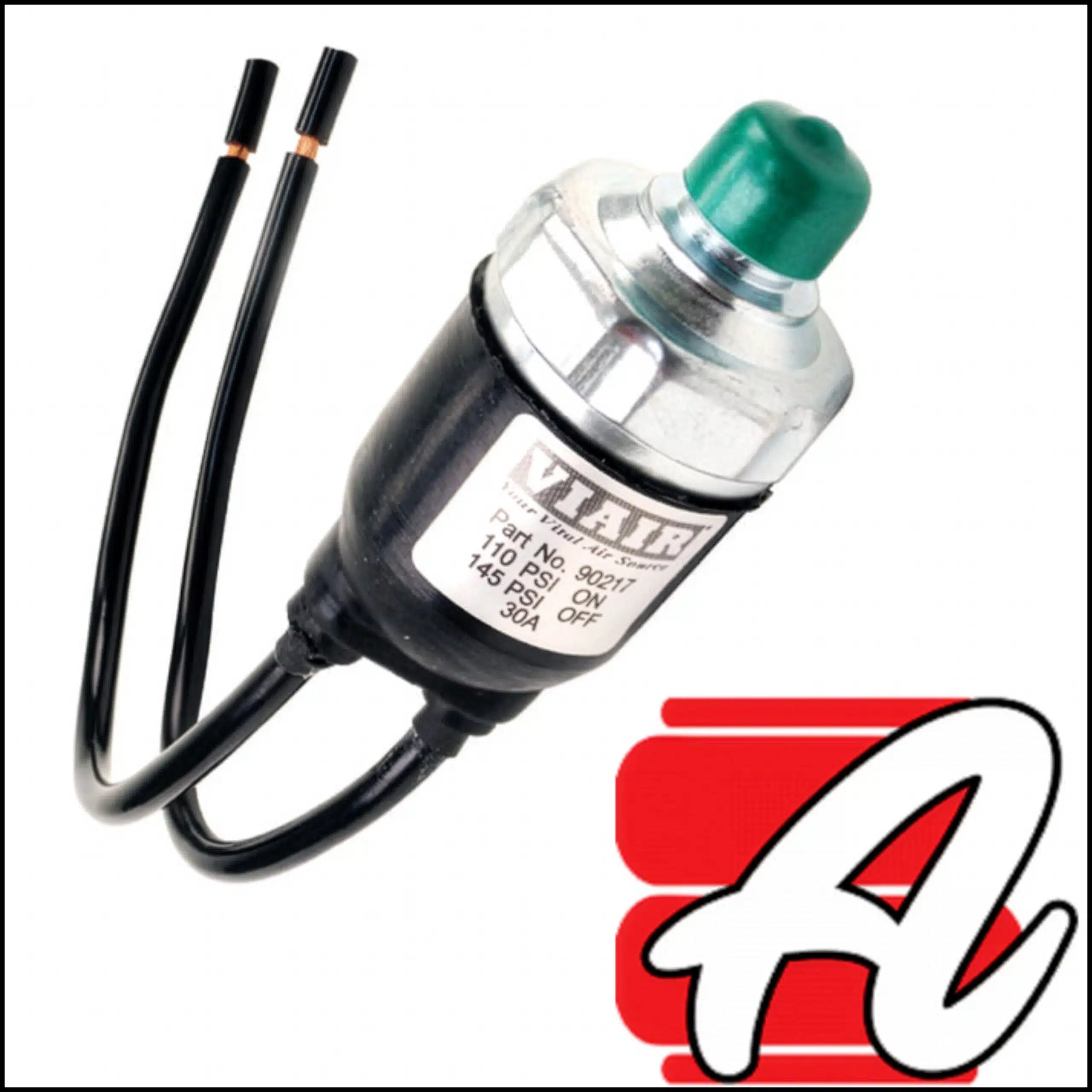


We sell quite a lot of pressure switches, usually shortened to PS, and closely related to them, pressure relief valves, usually shortened to PRV. They are simple parts, but they are important ones. A lot of confusion surrounds both, especially when customers are repairing older systems, replacing failed parts on budget installations, or putting together a non-digital setup themselves.
This blog post explains what each part does, how they work together, where they should be fitted, and a few common mistakes to avoid.
What Does a Pressure Switch Do?
A pressure switch, usually shortened in our diagrams and instructions to PS, turns the compressor on and off automatically based on tank pressure, via a relay.
It has two pressure figures associated with it:
- The lower number, where it switches the compressor on - cut-in pressure, or CIP.
- The upper number, where it switches the compressor off - cut-off pressure, or COP.
For example, a 110 - 145 PSI pressure switch should switch the compressor on at about 110 PSI and switch it off at about 145 PSI. When you first install the system and there is no pressure in the tank, the pressure is below the cut-in pressure, so the switch signals the compressor, via a relay, to start and fill the tank. When the tank reaches around 145 PSI, the switch opens and the compressor stops. As air is used, nothing happens until tank pressure drops below the cut-in pressure again, at which point the compressor starts and the cycle repeats.
This is what allows an onboard air system to maintain tank pressure without the compressor running all the time. In simple terms, the pressure switch is the automatic compressor control on a non-digital, tank-based setup.
What Does a Pressure Relief Valve Do?
A pressure relief valve, usually shortened to PRV, is a safety device.
Its job is not to control normal compressor operation. Its job is to protect the tank and system if something goes wrong and the air pressure gets too high. This can be caused by a pressure switch failure, but in our experience it is more commonly caused by installer wiring errors, which we have seen many times, or by an abnormal situation such as accident damage, a crushed tank, or fire exposure. The valve is there to vent the pressure before it becomes a danger.
If the system exceeds the relief valve setting, the valve opens and releases air to atmosphere. On most PRVs this is accompanied by a very obvious and very loud discharge of air.
In other words:
- The pressure switch controls normal operation.
- The pressure relief valve is the back-up safety device.
You should have both on any tank-based onboard air system.
Why Both Are Needed
Some people assume that if they have a pressure switch they do not need a pressure relief valve. This is wrong.
Pressure switches are mechanical items and, like any mechanical or electrical component, they can fail. Wiring can also be wrong. Relays can stick. Compressors can be modified or miswired.
The PRV is there to protect the system in the event of a situation that should never happen, but sometimes does.
Understanding the Numbers on a Pressure Switch
Customers often ask what the two numbers actually mean.
Using a common example:
110 - 145 PSI
This means:
- Compressor on at around 110 PSI.
- Compressor off at around 145 PSI.
The first figure is the cut-in pressure.
The second figure is the cut-off pressure.
That upper number is the important one when selecting the pressure relief valve.
Pressure Switch Accuracy and Why PRV Setting Matters
Most pressure switches are not laboratory instruments. On most air suspension pressure switches, a tolerance of around 5% is normal, and up to 10% should be anticipated.
That means the actual cut-off point can vary slightly from the stated figure. A 145 PSI switch may not always cut off at exactly 145 PSI. It may be a little under or a little over.
That is why the pressure relief valve should not be set too close to the switch cut-off pressure.
As a rule, the PRV should be at least 10 - 15% higher than the maximum pressure switch cut-off figure, and often a little more is sensible. So if your pressure switch cuts off at 145 PSI, the PRV wants to be comfortably above that, not almost the same.
If you set the PRV too close to the pressure switch maximum, normal variation in the switch can cause nuisance venting, where the PRV opens during ordinary operation. That is not what it is for. It is also very annoying indeed because it is very loud.
The pressure relief valve is there for fault protection, not for day-to-day regulation.
Where Should They Be Fitted?
Pressure Switch Location
Pressure switches should be fitted into the air tank where they can read true tank pressure. They should not be fitted somewhere random in the system where pressure may be delayed, restricted, or not represent actual tank pressure properly.
Just as importantly, they should not be fitted in the bottom of the tank. This matters a lot.
Compressed air creates condensation. Water accumulates in the tank. The bottom of the tank is where moisture collects, and if you fit the pressure switch there, moisture will sit in it. Sooner or later that tends to kill it. If you want pressure switches to last, keep them out of the lowest point and drain the tank properly and regularly.
Pressure Relief Valve Location
The same basic rule applies to the pressure relief valve. It should be fitted where it is directly protecting tank pressure, but not in the bottom of the tank.
Again, the bottom of the tank is where water collects. A PRV sitting in water is not ideal, and neither is anything else. Moisture is bad news for air suspension systems full stop.
Drain Your Tank - Seriously
If you have onboard air with a tank, you need to drain it.
This gets neglected all the time and it causes all sorts of avoidable trouble. Moisture in the tank contributes to pressure switch failure, contaminates valves and fittings, and in colder conditions can create freezing problems too.
A tank should be drained regularly. Exactly how often depends on use, climate and the quality of moisture control in the system, but "never" is not the answer.
If you do not drain the tank, eventually the water will start finding the weak points for you. Water can also cause the pressure switch to fail and the PRV to seize or behave unreliably.
The PRV is not a drain tap. That may sound obvious, but we once had a customer who thought the ring on the end of the PRV was there to drain water from the tank. It is not. Pulling that ring manually opens the valve to test that it functions. It is a test feature, not a drain. If you want to remove water from the tank, use a proper drain point and actually drain the tank.
How to Test a Pressure Switch
Testing a pressure switch is fairly simple in principle.
The best way is to have:
- A tank.
- A working compressor.
- A gauge you can trust.
Then watch what happens.
The compressor should run until the upper pressure is reached, then switch off. If you vent pressure from the tank back down, the compressor should switch back on at the lower pressure point.
A gauge does not have to be complicated or expensive, but without one you are largely guessing what the pressure switch is actually doing.
What you are checking is:
- Does it switch off roughly where it should?
- Does it switch back on roughly where it should?
- Does it do it consistently?
Do not expect the exact stated number to be perfect every time. As noted above, most switches have a tolerance of around 5%.
If the compressor keeps running far beyond the expected cut-off point, switch the system off and investigate immediately. Do not assume it will sort itself out.
How to Test a Pressure Relief Valve
A PRV can be tested in two ways.
The first is the basic manual test. Most have a ring which can be pulled briefly to confirm the valve opens and releases air. This shows that it is not stuck shut.
The second is by verifying that the valve opens at the correct pressure if the system pressure rises too high, but this is not something to do at home unless you know exactly what you are doing and the system is set up safely for it.
For most users, the sensible test is the manual one:
- Make sure there is pressure in the tank.
- Pull the ring briefly.
- Confirm that air is released.
- Release the ring and confirm the valve reseats.
- At low pressure, or when empty, the ring will be hard to pull. When full, the ring will be easier to pull.
Again, this is a function test, not a way of draining condensate.
Viair Pressure Switches - Why We Use Them
Our pressure switches are Viair items with 1/8 NPT male threads.
Could we get cheaper ones? Yes, easily.
Do we want to? No.
Viair pressure switches work extremely well and have proved extremely reliable for us. We have been using them for around 25 years and cannot recall failures on our own systems. In the real world that matters far more than saving a few pounds buying something that only looks similar.
A lot of customers contact us because they are trying to replace failed cheap switches on systems built with budget parts that look broadly the same but are very different in quality. Others are putting together non-digital management systems themselves and want parts they can trust.
In our view this is one of those areas where buying the proper part makes sense. The pressure switch is a small component, but if it fails it can make the whole system unreliable or unsafe.
What Systems Use a Pressure Switch and PRV?
These parts are typically used on tank-based, non-digital systems.
They are common on:
- Motorhome onboard air setups.
- Pickup onboard air setups.
- Non-digital manual systems.
- Simple compressor and tank installations.
They are generally not used in the same way on computer-controlled systems such as Air Lift 3P or ALP4, where pressure sensing and compressor control are handled by the electronic management system.
About 25 years ago the kinds of switches and valves discussed here were used on pretty much all car installs as well, because digital control was nowhere near as common as it is now. These days, for cars, they are mostly limited to non-digital systems, whereas for motorhomes, pickups and general onboard air they remain very common.
Common Mistakes to Avoid
A few of the most common errors we see are:
- Fitting the pressure switch in the bottom of the tank.
- Fitting the PRV in the bottom of the tank.
- Never draining the tank.
- Using the PRV as if it were a drain valve.
- Choosing a PRV setting too close to the pressure switch cut-off pressure.
- Assuming two similar looking switches are interchangeable when they are not.
- Buying very cheap parts for a system that depends on reliability.
- Fitting either into an airline instead of the tank.
Air suspension is full of components that look similar in photos. That does not make them equal.
Final Thoughts
Pressure switches and pressure relief valves are not glamorous parts, but they are essential ones on many onboard air systems.
- The pressure switch controls when the compressor runs.
- The pressure relief valve protects the system if pressure rises too high.
- Both need to be fitted properly.
- Neither should be fitted in the bottom of the tank.
- And if you have a tank, you need to drain it.
If you are replacing tired parts on an existing setup or building a non-digital system from scratch, it is worth understanding how these components work together rather than just fitting whatever looks about right.
As with many things in air suspension, small details make a big difference. Quality components make a difference. If you need more information for your own install, please get in contact.